1. Controllable Chorale Generation with Behavior-Inspired Neural Networks
Advisors: Christine Allen-Blanchette and Yulong (Arthur) Yang
AI · Multi-Agent Systems · Music Generation
This project develops a controllable Bach-style chorale generator that combines a Behavior-Inspired Neural Network (BINN) with explicit music-theory rules. The model treats soprano, alto, tenor, and bass as interacting agents and learns context-dependent patterns of voice motion from Bach chorales. A valence-arousal-tension (VAT) planner provides high-level control over the generated music, while theory constraints preserve four-part-writing structure. Experiments show that higher arousal produces denser rhythms and a wider register, while higher tension increases chromaticism. Additional analyses show that BINN meaningfully shapes the generated music and learns local voice-motion patterns that generalize to Bach chorales not used in training.

Generated Audio Samples
Within each comparison, the starting chorale and rollout seed are held fixed so that the examples illustrate the effect of changing the requested VAT level.
2. From Sound to Structure: What Total Roughness Misses in Complex Music
Computational Music Cognition · Acoustics · Machine Learning
This research examines why the standard prediction that minor intervals are rougher than major intervals nearly disappears in complex real music. Using 18,486 recordings, the study finds that the difference is not simply lost with complexity. Instead, different groups of frequency pairs contribute in opposing directions, causing much of the major-minor roughness difference to cancel. The analysis shows that minor-like recordings contain more roughness-relevant frequency pairs, while major-like recordings distribute spectral amplitude more evenly, strengthening individual pair contributions. When these amplitude differences are computationally removed, the predicted minor-rougher relationship reappears. Overall, the study shows how meaningful acoustic structure can remain hidden when opposing spectral effects are compressed into a single aggregate measure.
Angela’s research explores the intersection of economics, artificial intelligence, mathematics, and music, with a focus on technology, creative markets, and musical behavior.

Under the observed amplitudes, different frequency ranges favor major-like and minor-like tracks, producing cancellation and a small overall effect (d=+0.03). After equalizing amplitudes while preserving frequency locations, all eight ranges favor minor-like tracks and the overall effect increases to d=+0.24. This shows that amplitude distribution offsets much of the minor-rougher tendency associated with frequency arrangement.
3. The Two Music Economies: Automation Exposure and Market Divergence in Royalty-Free Music
Economics · Generative AI · Digital Markets
This research examines whether music genres that are more amenable to scalable digital production evolve differently from genres that depend more heavily on distinctive performance and artistic identity. The findings reveal a growing divergence: more automation-exposed genres experience larger relative declines in active-seller participation and average purchase prices, while less-exposed genres show greater resilience. Importantly, these patterns appear to reflect a broader, longer-running process of digital automation rather than a discrete shift associated with the recent emergence of generative AI.
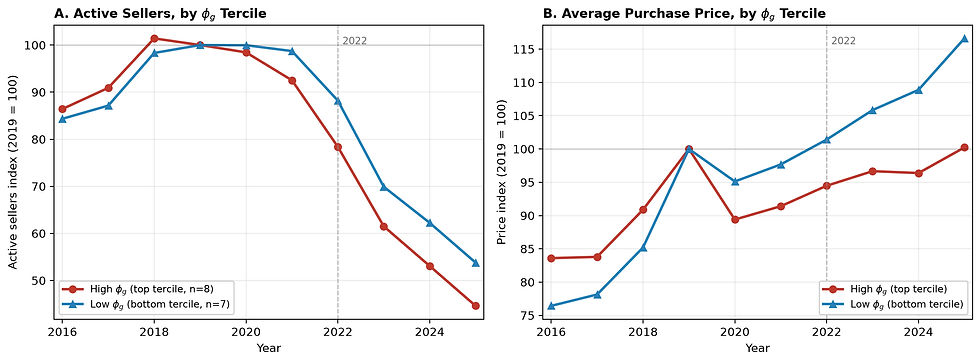
This figure compares trends in active sellers and average purchase prices across music genres with different levels of automation exposure. Higher-exposure genres experience larger declines in active sellers and weaker price growth.
4. "Spinning Back:The Resurgence of Vinyl", Journal of Future Economists, 2026
Student authors: Derek Hu, Jane Hu, Zachary Ji, Benjamin Li, Kanishk Mogha, Aritra Ray, Helen Yu, and Angela Zhang. Faculty advisor: Katie Dineen